SEO, AEO, GEO and AIO checklist for 2026: how to optimise a website for Google and AI search
One checklist for ranking in Google and being cited in AI answers, built from what Google, Bing, OpenAI, Anthropic and Perplexity publish and the largest studies, checked on 27 October 2026. With the myths to skip and the best YouTube videos on each topic.
30 min readBy the Veridian Code team
Want this set up for your business? See our Technical & On-Page SEO service →
Most guides to AEO, GEO or AI SEO are written to sell a new service. This one is a working checklist, the same one we use on veridiancode.com and on client sites. We checked it against what Google, Microsoft (Bing and Copilot), OpenAI, Anthropic and Perplexity publish, the largest independent studies and the most-watched videos on the subject, as of 27 October 2026. Where a point is our own advice rather than a source's, we say so. If you only need the definitions, our shorter guide to AEO and GEO vs SEO covers them.
SEO, AEO, GEO and AIO in one table
| Term | Stands for | The goal | Where it shows |
|---|---|---|---|
| SEO | Search engine optimisation | Rank in search results and earn the click | Google and Bing results |
| AEO | Answer engine optimisation | Be the answer: featured snippets, People Also Ask, voice and AI answers | Google, Gemini, voice assistants and AI chat tools |
| GEO | Generative engine optimisation, a term from a 2023 IIT Delhi and Princeton research paper | Be cited or mentioned in answers written by AI | ChatGPT, Gemini, Perplexity, Claude, Copilot, Google AI Overviews and AI Mode |
| AIO | Either AI optimisation (another name for GEO) or short for Google's AI Overviews | Depends on who is using it, so ask | As GEO, or AI Overviews specifically |
The search companies don't treat these as separate disciplines. Google's guide to optimising for its generative AI features, added on 15 May 2026, files AEO and GEO under SEO and lists the AI-specific tricks it ignores. Microsoft uses the word GEO itself, calling Bing's AI citation report an early step towards GEO tooling, and its guidance makes a similar point: AI answers share the same foundation as ordinary search (crawling, understanding and ranking the web), even though grounding an answer is optimised for a different outcome. So the fundamentals come first, and the AI-specific work sits on top of them.
What changed in search in 2025 and 2026
If your SEO knowledge dates from 2024, these are the changes that matter most. Every date comes from the company's own announcement or documentation, or from the reports listed under Sources.
| When | What changed | What it means for you |
|---|---|---|
| Jun 2025 to Oct 2025 | Google AI Mode reached India: a Labs test from 24 June, everyone from 8 July 2025, Hindi from 8 September and seven more Indian languages from 8 October | Indian searchers can get a full AI-written answer, in their own language, before any link |
| Mar 2025 to Sep 2026 | Five Google core updates (March, June and December 2025; March and May 2026) and five spam updates (August 2025; March, June, August and September 2026) | Google described each core update only in general terms; there is no single fix to chase |
| Nov to Dec 2025 | The Business Profile Q&A API ended on 3 November 2025, and Google began answering customers' questions with AI instead of public Q&A | Q&A seeding no longer works; complete, accurate profiles and reviews feed the answers |
| Jan to Mar 2026 | AI Overviews moved to Gemini 3; afterwards Ahrefs found only 38% of cited pages in the top 10 for the query | Ranking for the main keyword is no longer enough; cover the questions around it |
| 3 Feb 2026 | Google documented that Googlebot reads only the first 2 MB of an HTML file | Keep the title, canonical and structured data near the top of the HTML |
| 10 Feb 2026 | Bing Webmaster Tools launched an AI Performance report showing citations in Copilot and Bing's AI answers | A free report of AI citations, page by page (Bing calls it a first) |
| 12 Mar 2026 | Google Maps launched Ask Maps, conversational search powered by Gemini, in the US and India | Business Profiles and reviews feed AI answers inside Maps |
| Apr to Jun 2026 | Back button hijacking added to Google's spam policies on 13 April, enforced from 15 June | Check that no script or ad library traps visitors on your page |
| 7 May 2026 | FAQ rich results stopped appearing in Google Search | FAQ markup does no harm, but it no longer earns anything in Google |
| 13 May 2026 | GA4 added a default AI Assistant channel | Visits from assistants such as ChatGPT, Gemini and Claude are grouped for you |
| 15 May 2026 | Google published its guide to generative AI features, and its spam policies began to cover attempts to manipulate AI answers | The official position: optimising for AI search is SEO, and gaming it is spam |
| Jun to Aug 2026 | Search Console added a Generative AI performance report and a site-wide AI features control, rolled out to all sites by 31 August | You can now see impressions in AI Overviews and AI Mode, though not clicks |
| 15 Jun 2026 | Google clarified that Google Search doesn't use llms.txt | An llms.txt file is optional and has no effect on Google |
| 29 Aug 2026 | ChatGPT ads went live in India | Paid placements now sit beside AI answers; OpenAI says ads don't change the answers |
| Oct 2026 | Google's guidance now names effort, originality, talent or skill, and accuracy as what raters judge, and says AI-generated content must be fact-checked before publishing | Visible human work is now written into Google's quality guidance |
How Google and AI assistants find, read and cite a page
Every answer, whether it is a blue link, an AI Overview or a ChatGPT reply, comes out of the same chain. A crawler fetches your page, a system reads and stores it in an index, a ranking system retrieves it for a question, and the result is shown as a link or used as a source for an AI-written answer. A page that fails an early step never reaches the later ones.
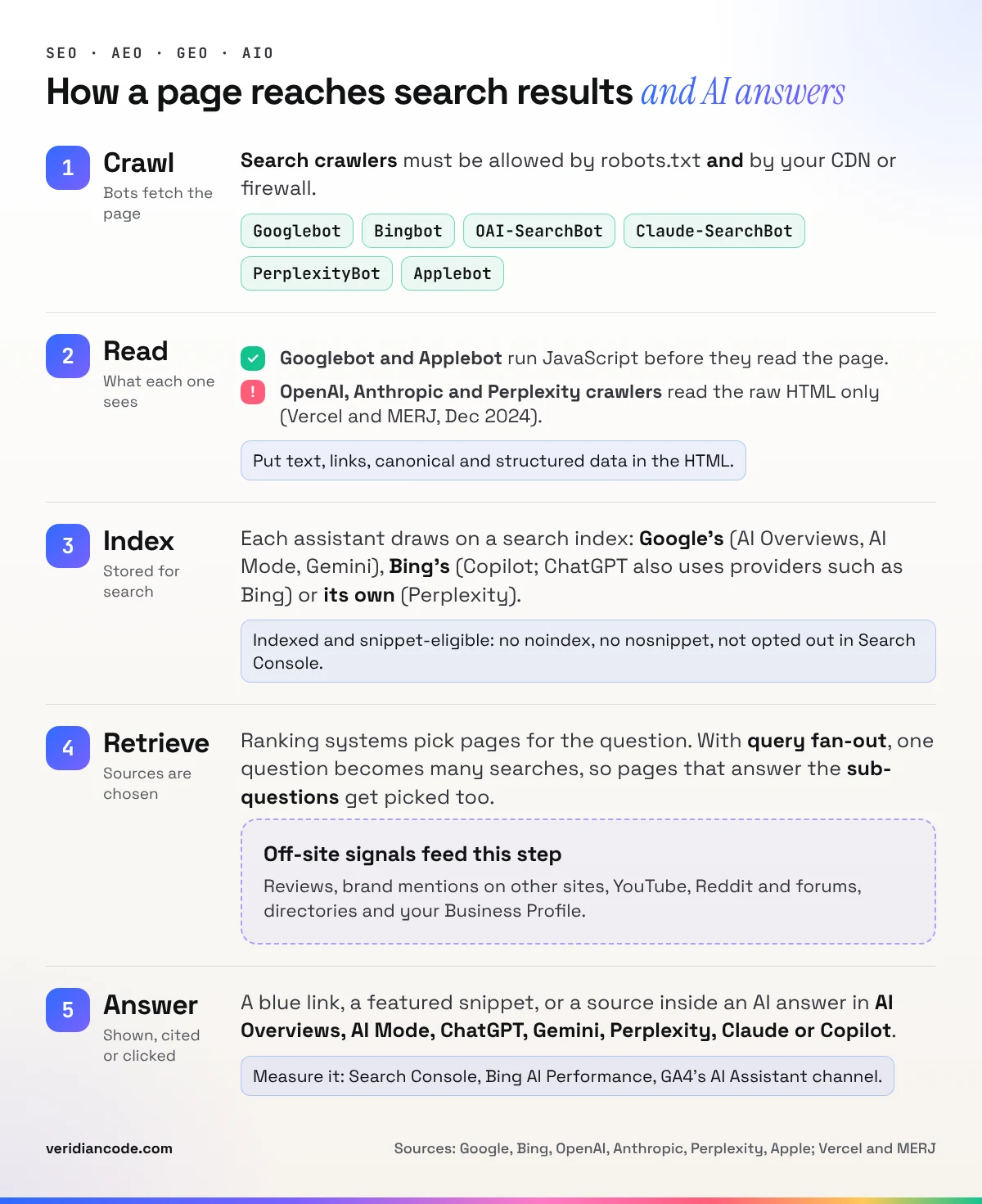
Two details in this chain catch out most websites.
- JavaScript. Google renders JavaScript in a recent version of Chrome before indexing. The crawlers from OpenAI, Anthropic and Perplexity fetch your HTML but don't run your scripts, according to a study of billions of crawler requests by Vercel and MERJ (December 2024). A smaller Resoneo test in January 2026 found the same for the fetchers ChatGPT, Claude and Perplexity use when a user asks them to read a page. A React or no-code site that sends an empty shell can rank in Google and still be invisible to ChatGPT, Claude and Perplexity.
- Query fan-out. AI Mode and AI Overviews split a question into several related searches and draw sources from each. That is one reason Ahrefs found that only 37.9% of pages cited in AI Overviews ranked in the top 10 for the original query in early 2026, against 76% in mid-2025 (Ahrefs also changed its method between the two). Covering the questions around a topic now matters as much as ranking for the main term.
Which crawler does what
| Company | Search crawler (allow it to be cited) | Training crawler or token (your choice) | User-requested fetches |
|---|---|---|---|
| Googlebot | Google-Extended (covers Gemini training and Gemini app grounding, not Google Search) | Google-Agent and others | |
| Microsoft (Bing, Copilot) | Bingbot | — | — |
| OpenAI (ChatGPT) | OAI-SearchBot | GPTBot | ChatGPT-User |
| Anthropic (Claude) | Claude-SearchBot | ClaudeBot | Claude-User |
| Perplexity | PerplexityBot | None (Perplexity says PerplexityBot isn't used for training) | Perplexity-User |
| Apple (Siri, Spotlight) | Applebot | Applebot-Extended | — |
| Meta (Meta AI) | meta-webindexer | meta-externalagent | meta-externalfetcher |
Technical SEO checklist
Technical SEO decides whether anything else counts. None of it is new, but the rise of crawlers that read only raw HTML has raised the bar for JavaScript sites.
- Send full HTML, without relying on JavaScript. Each page's text, title, meta description, canonical, hreflang, Open Graph tags and structured data should be in the HTML your server sends, through server-side rendering or prerendering. Google calls dynamic rendering, a separate version for bots, a workaround rather than a solution. To test it, open "view source" or fetch the page with curl: if the words aren't there, most AI crawlers can't see them. Evidence: Official and Study.
- Mind the 2 MB limit. Googlebot reads the first 2 MB of an HTML file, measured uncompressed. Keep the title, canonical and JSON-LD in the head, not after large blocks of inline script. Evidence: Official.
- Let the right crawlers in. Your robots.txt, firewall and CDN bot settings should allow Googlebot, Bingbot, OAI-SearchBot, Claude-SearchBot, PerplexityBot and Applebot. Some CDN bot-protection settings block AI crawlers by default, so test each user agent rather than trusting robots.txt alone. Evidence: Official and Practice.
- Index only what deserves it. One canonical URL per page, a self-referencing canonical, noindex rather than robots.txt to keep a page out of Google, and a real 404 or 410 for pages that don't exist. A missing page that returns your homepage with a 200 status is a soft 404 that wastes crawling. Evidence: Official.
- Permanent redirects for permanent moves. Use 301 or 308 redirects and keep them for at least a year. Pick one host (with or without www) and one trailing-slash style, and use it in links, canonicals and sitemaps. Google treats 302 and 307 redirects as temporary and doesn't use them as a signal that the new URL should replace the old one. Evidence: Official.
- A clean XML sitemap. Only canonical, indexable URLs, at most 50,000 URLs or 50 MB per file, with honest lastmod dates. Google and Bing both ignore the priority and changefreq tags. Submit it in Search Console and Bing Webmaster Tools. Evidence: Official.
- Core Web Vitals in the green. Measured at the 75th percentile of real visits (table below). Google says Core Web Vitals are used by its ranking systems but that there is no single page experience signal, so fix what is red rather than chasing a perfect lab score. Never lazy-load the main image at the top of the page. Evidence: Official.
- The same content on mobile. Since July 2024 Google indexes with its smartphone crawler only, so the mobile page needs the same text, links and structured data as desktop. Evidence: Official.
- Crawlable links and a shallow structure. Use real HTML links (an a element with an href), not click handlers. Keep important pages a few clicks from the homepage, and make sure every page is linked from at least one other page. Evidence: Official and Practice.
- hreflang done right on multilingual sites. Each language version lists every other version and itself, plus an x-default, and the links must be reciprocal or Google ignores them. Review translations properly: Google's scaled content abuse policy covers automated translation used to mass-produce low-value pages. Evidence: Official.
- Structured data that matches the page. Organization or LocalBusiness on the homepage or about page, WebSite for your site name, BreadcrumbList, Article on articles, and Product, Event or VideoObject where they apply. Don't mark up anything visitors can't see, and don't add review stars to your own business, which Google treats as self-serving. Evidence: Official.
- Images and video Google can index. Real img elements in the HTML (Google doesn't index CSS background images) with descriptive alt text and file names, in WebP or AVIF, with width and height set. Videos need a page whose main purpose is the video and a stable thumbnail. Evidence: Official and Practice.
- HTTPS everywhere, and no pop-ups that hide the page. Evidence: Official.
- Tell Bing straight away. Verify Bing Webmaster Tools and send new or changed URLs through IndexNow, which also reaches Yandex, Naver, Seznam and others. Google doesn't take part in IndexNow, so for Google rely on your sitemap and the URL Inspection tool. Evidence: Official.
| Core Web Vital | Good | Needs improvement | Poor |
|---|---|---|---|
| Largest Contentful Paint (LCP): loading | 2.5 s or less | 2.5 to 4.0 s | More than 4.0 s |
| Interaction to Next Paint (INP): responsiveness | 200 ms or less | 200 to 500 ms | More than 500 ms |
| Cumulative Layout Shift (CLS): visual stability | 0.1 or less | 0.1 to 0.25 | More than 0.25 |
On-page SEO and content checklist
Google's helpful content guidance now spells out what its quality raters look for in a page's main content: effort, originality, talent or skill, and accuracy. It also says that using AI to produce large amounts of text without human oversight counts as little to no effort. That is the standard this section is built around.
- One page for each search intent. Look at the live results first: are they guides, product pages, comparisons or tools? Cover a group of closely related searches on one page. Don't make a page for every variation of a query or every fan-out question; Google's 2026 guide names that as scaled content abuse. Evidence: Official.
- Say something that isn't already published. Google calls this non-commodity content: first-hand experience, original data, tests, case results, screenshots and a clear point of view. A rewrite of the top ten results adds nothing for a reader, or for an AI that has already read them. Evidence: Official.
- Answer first. Put the answer or summary at the top and skip the warm-up. Google's rater guidelines describe low-value padding near the top of a page as filler. Evidence: Official.
- Titles that match the page. Unique, descriptive, not exaggerated, with the brand at the end. Google sets no length limit, but in Zyppy's study of 80,959 titles, those of 51 to 60 characters were rewritten least often. Keep the title and the H1 in agreement, including any year. Evidence: Official and Study.
- A meta description written for people. Google often writes its own snippet but uses yours when it describes the page better. Make it a factual summary with specifics. Evidence: Official.
- Clear headings and sections. Descriptive H2s and H3s with one idea per section, plus a table of contents with stable anchor links on long pages. Heading order doesn't affect ranking, but it helps readers and screen readers. Keep key content visible rather than hidden in tabs, so Google can link to the exact section. Evidence: Official.
- Short, readable URLs with hyphens, in your reader's language. Evidence: Official.
- Internal links with descriptive anchor text. Every page should be linked from at least one other page, with anchor text that makes sense on its own. In Zyppy's study of 23 million internal links, URLs with 40 to 44 internal links got about four times the Google clicks of URLs with 0 to 4 (a correlation, not proof). Evidence: Official and Study.
- Cite your sources. Link to the primary source for every fact that isn't yours. Google says outbound links can help establish trust, and the original GEO study found that citing sources and adding statistics made content more visible in AI answers. Evidence: Official and Study.
- Honest authorship and dates. Readers should be able to see who wrote a page and who stands behind the site. Google accepts an organisation as the author in its Article markup, and a team byline linked to a real about page meets that bar. Never invent experts or use AI-made headshots, which Google calls deception. Show Published and Updated dates that match your structured data, and change them only when the content really changes. On health and money topics Google gives E-E-A-T (experience, expertise, authoritativeness and trust) extra weight, so we advise naming a qualified author or reviewer there. Evidence: Official and Practice.
- Use AI as a tool, not an author. Google allows AI-assisted content. Since 1 October 2026 its guidance says all AI-generated content, including titles, descriptions, structured data and alt text, should be fact-checked by a person before it is published. Evidence: Official.
- Length is whatever the question needs. Google has no preferred word count, and Ahrefs found a correlation of about 0.04, close to none, between word count and AI citations. Evidence: Official and Study.
- Refresh rather than redate. Review time-sensitive pages after each core update and at least every quarter, and evergreen pages every 6 to 12 months; say what changed. Merge or redirect weak pages that compete for the same intent. Evidence: Practice.
One finding from the US antitrust case against Google is worth knowing. The court's opinion describes NavBoost, a system that remembers which results people clicked for a query, trained on 13 months of data. It is one more reason to write titles that deliver what they promise and pages that end the search, rather than sending people back to the results.
Off-page SEO: links, mentions and brand
Links still count. Google's ranking systems guide says PageRank is still one of its core ranking systems. But Google has also played links down: in April 2024 its analyst Gary Illyes said Google needs very few links to rank pages, though he later said he shouldn't have said it. For AI answers, the evidence points to brand mentions. In Ahrefs' study of 75,000 brands, mentions of a brand across the web correlated at 0.66 to 0.71 with its visibility in ChatGPT, AI Mode and AI Overviews, mentions on YouTube at about 0.74, and backlink-based metrics far less. A University of Toronto study (2025) found that AI search engines lean heavily on earned, third-party media rather than brands' own sites. Both are correlations, and the Ahrefs sample leans towards larger sites, but they point the same way.
What works in 2026
- Original data that people want to cite: a survey, a price index, or an analysis of your own anonymised data, offered to journalists and writers who cover your field. Evidence: Study and Practice.
- Expert comment for journalists. HARO is running again under Featured.com, and Qwoted and Source of Sources also connect experts with reporters. Answer quickly and briefly, and only where you have real expertise. Evidence: Practice.
- Tools and pages worth linking to: calculators, checkers, templates and statistics pages. Ahrefs notes that clicks are shifting towards these action queries, which an AI answer can't complete. Evidence: Practice.
- Reclaim unlinked mentions and broken links pointing to pages that have moved. Evidence: Practice.
- Real relationships: client credits, partner and supplier pages, associations, events, podcasts and YouTube appearances that say your brand name. Mark any link given in exchange for something with rel="sponsored". Evidence: Official and Practice.
- Directories and review platforms, for trust rather than PageRank. Clutch, GoodFirms, G2 and industry directories matter to buyers and to AI tools that read them, though Clutch's own help pages say its profile links are nofollow. Keep your business name, contact details and services identical everywhere. Evidence: Study and Practice.
- Genuine community answers on Reddit, Quora and LinkedIn, as a named and disclosed expert. Evidence: Practice.
What gets a site penalised
Google's spam policies treat as link spam: bought links that pass ranking credit, links exchanged for goods or services, excessive link swaps, keyword-rich links in guest posts and press releases, low-quality directory and bookmark links, widget and footer link schemes, and links required by contract. Google's 2026 guide adds that seeking inauthentic mentions doesn't help in AI search either. Use the disavow tool only after a manual action, or if you or a past agency bought links; Google's John Mueller said in 2025 that the disavow tool isn't part of normal site maintenance.
Local SEO and Google Business Profile
Google ranks local results on relevance, distance and prominence, and says no one can pay for a better local ranking. In Whitespark's 2026 survey of 47 local search experts, the top map-pack factors were the primary Business Profile category, proximity, and keywords in the business name, although keywords added to a business name break Google's guidelines. A dedicated page for each service topped local organic results, and third-party "best of" lists and mentions topped AI visibility. AI answers to local questions lean on Business Profiles: in BrightLocal's August 2026 study across the US, UK and Australia, the Business Profile was the top source for local answers in AI Overviews and AI Mode, while ChatGPT leaned on Yelp and other directories.
- Verify and complete your Business Profile: a primary category that says what the business is, then services, hours, service areas, photos and a plain description. Use your real-world business name and nothing else. Evidence: Official.
- Match your details everywhere. The name, address and phone number on your website should match your profile exactly, with LocalBusiness markup on the site. Keep the same details on the directories that matter in your market; in India that usually means Justdial, Sulekha and IndiaMART, plus Apple Business and Bing Places. Evidence: Official, Study and Practice.
- One strong page per service, and per real location. City pages that swap only the place name are doorway pages under Google's spam policies. Evidence: Official.
- A steady flow of genuine reviews. Ask every customer, reply within days, and never pay for reviews, offer discounts for them, or ask only the happy customers. In BrightLocal's 2026 consumer survey, 74% of US consumers considered only reviews from the last three months, and 45% used ChatGPT or other AI tools for local business recommendations, up from 6% a year earlier. Evidence: Official and Study.
- Drop what's gone. Public Q&A on Business Profiles was replaced with AI answers in late 2025; chat and Business Profile websites were removed in 2024. Evidence: Official.
AEO: how to become the answer
The answer boxes on Google have changed shape. In Ahrefs' sample of a million results pages, featured snippets fell from 15.41% of pages to 5.53% between January and June 2025, while AI Overviews rose from 3.93% to 27.43%. People Also Ask stayed common, on 79% of pages in June 2025. AI Mode passed a billion monthly users in May 2026, Google says, and since October 2025 Search Live has let people in India ask questions out loud in English and Hindi.
Fewer people click when an answer is on the page. Pew Research found US users clicked a result in 8% of visits with an AI summary against 15% without one, and clicked a link inside the summary in 1%. Ahrefs measured a 58% lower click-through rate for the top result when an AI Overview appeared. SparkToro and Similarweb put US zero-click Google searches at 68% in early 2026. The useful finding comes from Seer Interactive: pages cited inside the AI Overview got about 120% more clicks per impression than pages that weren't, though still fewer than when no AI Overview appeared. Commercial and transactional searches are far less affected; in Seer's data, AI Overviews appeared on 36% of informational queries but 8% of commercial and 5% of transactional ones.
Write answers that can be lifted
- Use the question as the heading where people ask it that way. Evidence: Practice.
- Answer it in the first one to three sentences under the heading, in plain text, then add the detail, numbers and examples. We found no study behind the popular "40 to 60 words" rule; aim for a complete, direct answer. Evidence: Practice.
- Use lists for steps and tables for comparisons when the content really has that shape. Evidence: Practice.
- Cover the follow-up questions on the same page, not on a thin separate page for each. Evidence: Official.
- Keep answers visible, not behind tabs, and check that no nosnippet or max-snippet rule stops Google from quoting them. Evidence: Official.
- Find the questions in Search Console (filter queries for who, what, how and why), in People Also Ask, in tools such as AlsoAsked and AnswerThePublic, and in your own sales calls and emails. Evidence: Practice.
GEO and AIO: getting cited by ChatGPT, Gemini, Perplexity, Claude and Copilot
Each assistant gets its sources from a search index, so the first question is which one.
| Assistant | Where it finds sources | What to do |
|---|---|---|
| Google AI Overviews and AI Mode | Google's index and core ranking systems, with query fan-out | Be indexed and eligible for a snippet; rank for the questions around your topic |
| Gemini app | Grounding with Google Search, controlled by Google-Extended | Leave Google-Extended unblocked if you want Gemini to use your pages |
| Microsoft Copilot | Bing's index | Bing Webmaster Tools, IndexNow, and Bing's AI Performance report |
| ChatGPT search | OpenAI's OAI-SearchBot plus third-party search providers, which OpenAI says include Bing | Allow OAI-SearchBot, be indexed in Bing; ChatGPT links carry utm_source=chatgpt.com |
| Perplexity | Its own index, scored passage by passage | Allow PerplexityBot; write sections that make sense on their own |
| Claude | Anthropic's web search; Anthropic says Claude-SearchBot indexes pages to improve its search results | Allow Claude-SearchBot |
What the research says works, and how strongly
| Tactic | Evidence | Strength |
|---|---|---|
| Rank in the underlying search engines for the question and its sub-questions | Google says its AI features retrieve with its core ranking systems; the C-SEO Bench study (2025) found classic ranking beat AI-targeted rewrites | Strong |
| Earn genuine mentions on other sites, review platforms, YouTube and forums | Ahrefs, 75,000 brands: correlations of 0.66 to 0.74; Toronto study (2025): AI search favours earned media | Strong, but correlational |
| Original, specific content: data, first-hand detail, clear facts | Google's non-commodity guidance; Bing says grounding favours discrete facts with clear provenance | Strong (official guidance) |
| Add statistics, quotations and cited sources | GEO study (KDD 2024): up to about 40% more visibility in a lab test, mostly for lower-ranked pages | Moderate |
| Keep content current with real updates | Ahrefs: pages cited by AI assistants were 25.7% fresher than organic results; AI Overviews were the exception | Moderate |
| Sections that stand on their own, with clear headings and tables | Bing recommends clear headings, tables and FAQs; Google says there is no need to chunk content | Mixed |
| Structured data | Required by no assistant; an Ahrefs controlled test found no meaningful lift in AI citations; still needed for rich results | Weak for AI answers |
| llms.txt | Google doesn't use it; SE Ranking found no link with citations across 300,000 domains | No evidence |
| Keyword stuffing | GEO study: 8% less visible | Harmful |
The original GEO study, by researchers from IIT Delhi and Princeton and published at the KDD conference in 2024, tested nine ways of rewriting a page. Adding quotations, statistics and source citations helped most, and the gains went mainly to pages that were already retrieved but ranked lower: citing sources lifted the fifth-ranked source by 115% and lowered the first-ranked one. Later work is more cautious. The C-SEO Bench study found that most AI-targeted rewriting methods did little or harm, and that ranking well in the retrieval step mattered more. Our reading: write well-sourced, specific pages, then put most of the effort into being findable and being mentioned.
Allow the search crawlers, decide on the training ones
A plain robots.txt that allows everything is fine for most businesses. If you want to keep your content out of AI training but stay in AI answers, disallow GPTBot, ClaudeBot, Google-Extended, Applebot-Extended and CCBot, and leave Googlebot, Bingbot, OAI-SearchBot, Claude-SearchBot, PerplexityBot and Applebot allowed. OpenAI says changes to robots.txt take about 24 hours to reach its systems. Then check your CDN or firewall: a bot-blocking setting can undo what robots.txt allows.
Don't try to trick the machines
Hidden instructions to AI tools, "Summarize with AI" links that try to plant a brand in an assistant's memory, and "best" lists that rank their own author first all appear in the wild. Microsoft's security team found attempts of this kind from 31 companies in 60 days and calls it AI recommendation poisoning. Since May 2026 Google's spam policies cover attempts to manipulate generative AI responses, and Bing's webmaster guidelines now have a section on prompt injection and AI manipulation. In early 2026, Lily Ray reported that seven software sites with many self-promotional "best" lists lost between 29% and 49% of their search visibility, though Google hasn't confirmed the cause.
How to measure SEO, AEO and GEO
| What to track | Where | Watch out for |
|---|---|---|
| Clicks, impressions, CTR and position, branded and non-branded | Search Console Performance report, with the branded queries filter | Clicks from AI Overviews and AI Mode are counted in Web and can't be separated |
| Impressions in AI Overviews and AI Mode, by page | Search Console Generative AI performance report | Impressions only, no clicks or queries yet; available to all sites since 31 August 2026 |
| Citations in Copilot and Bing's AI answers | Bing Webmaster Tools AI Performance | Counts citations, not clicks |
| Visits and enquiries from AI assistants | GA4's AI Assistant channel (since 13 May 2026), or a custom channel group placed above Referral | An undercount: visits from apps often arrive with no referrer and land in Direct |
| Mentions and citations for a fixed set of buyer questions | Monthly manual checks, or trackers such as Otterly (from $29 a month), Semrush's AI Visibility Toolkit ($99) and Ahrefs Brand Radar (custom prompts from $50, AI Visibility Index from $199) | Answers change from run to run; report a share across many questions and runs, never a single rank |
| Calls, directions and website clicks | Business Profile performance | Local only |
| Core Web Vitals | Search Console Core Web Vitals report and PageSpeed Insights | Small sites may not have enough real-user data |
| How enquiries found you | A "How did you hear about us?" field on your enquiry form | Catches AI and word of mouth that analytics miss |
Treat AI traffic as valuable but small. Ahrefs reported that AI assistants sent 0.5% of its visitors but 12.1% of its sign-ups, while a peer-reviewed study in Marketing Science of 973 online shops found that ChatGPT visitors converted better than paid social but below every other established channel, organic search included. Both can be true for different businesses, which is why the enquiry form question matters.
Myths and outdated tactics to drop
| You may hear | What the evidence says |
|---|---|
| You need an llms.txt file or special AI files | Google Search doesn't use them (15 June 2026), no major AI company has said it relies on llms.txt, and a 300,000-domain study found no link with citations |
| Schema gets you into AI answers | Not required by Google; a controlled Ahrefs study found no meaningful lift in citations |
| FAQ schema wins rich results | FAQ rich results ended on 7 May 2026, and HowTo results in 2023 |
| Chunk your content for AI | Google says there's no need; write clear sections for people |
| Blocking GPTBot removes you from ChatGPT | GPTBot is for training; OAI-SearchBot decides ChatGPT search |
| Blocking Google-Extended removes you from AI Overviews | It doesn't; use Search Console's generative AI control or nosnippet |
| Longer content ranks better | Google has no preferred word count, and length barely correlates with AI citations |
| Keyword density and "LSI keywords" | Keyword stuffing is spam; Google's language systems handle synonyms on their own |
| The meta keywords tag | Google Search doesn't use it |
| Sitemap priority and changefreq | Google and Bing ignore both |
| Monthly toxic-link clean-ups | Disavow only after a manual action or if links were bought |
| Keywords in your Business Profile name | Against Google's guidelines, and a route to suspension |
| Rank number one and you'll be the AI citation | About 38% of AI Overview citations came from the top 10 in early 2026 |
| AI chat will replace Google soon | Google had 96.6% of India's search market in September 2026 (StatCounter), and Similarweb found 95% of ChatGPT users also used Google |
| Someone can guarantee a number one ranking or an AI mention | Google says no one can guarantee a number one ranking, and AI answers change constantly |
The best YouTube videos on SEO, AEO and GEO
We went through more than a hundred videos. The most-watched and the most reliable aren't the same list: Google's own Search Central videos get 10,000 to 20,000 views, while general courses get millions. These are the ones worth your time, with view counts as shown on YouTube on 27 October 2026.
Classic SEO: technical, on-page, links and local
| Video | Channel and date | Views | Watch it for |
|---|---|---|---|
| How Google Search Works (in 5 minutes) | Google, Oct 2019 | 20.7 million | How the index and ranking work, from Google itself |
| Complete SEO Course for Beginners | Ahrefs, May 2021 | 4.26 million | Search intent, keyword difficulty, on-page basics and link building in one course |
| SEO in 2025: How I'd Learn it if I Were Starting Over | Ahrefs, Apr 2025 | 569,000 | A modern order of learning for beginners |
| SEO Practical Full Course 2025 | WsCube Tech, Aug 2024 | 2.1 million | A widely watched Indian course, useful for basics; skip its submission-style link building and keyword density sections |
| How to perform a technical SEO audit | Google Search Central, Nov 2025 | 12,000 | Martin Splitt on reading audit tools critically and prioritising fixes |
| Keyword Research Tutorial: From Start to Finish | Ahrefs, Mar 2019 | 466,000 | Finding keywords and judging their difficulty and business value |
| Link Building for Beginners | Ahrefs, Jul 2020 | 342,000 | Linkable content, outreach, broken links and resource pages |
| Local SEO Masterclass: Darren Shaw on Ranking Factors, Reviews, and Google Business Hacks | Edward Sturm, Dec 2025 | 22,700 | The author of the Whitespark ranking factors survey on what moves local rankings |
| 5 Secrets to Optimize Your Google Business Profile in 2026 | Sterling Sky, Apr 2026 | 12,900 | Current Business Profile practice from a specialist local agency |
AI search: AEO, GEO and AI Overviews
| Video | Channel and date | Views | Watch it for |
|---|---|---|---|
| The Complete SEO & AI SEO Course for 2026 | Surfer Academy and Matt Kenyon, Apr 2026 | 326,000 | Intent, topic clusters and AI SEO in a 30-day plan |
| The New Rules of SEO (2026) | Neil Patel, Jul 2025 | 294,000 | Search everywhere optimisation: being trusted on the one or two platforms where your buyers decide |
| The ultimate guide to AEO: How to get ChatGPT to recommend your product | Lenny's Podcast with Ethan Smith, Sep 2025 | 191,000 | Turning paid-search terms, sales calls and Reddit threads into questions, and where AI citations come from |
| Learn 80% of AEO in 19 Minutes | Ahrefs, Jul 2026 | 118,000 | Answer-first sections, brand mentions and measuring AI referrals (its 76% top-10 figure predates Ahrefs' 2026 update) |
| Complete AI SEO Course for Beginners: Learn AEO in 86 Minutes | Ahrefs, Jun 2026 | 122,000 | The full version: how assistants retrieve, prompt research, content and tracking |
| How to Show Up in ChatGPT: HubSpot's Winning AEO Playbook | HubSpot Live, Nov 2025 | 88,000 | Mapping questions by persona and buying stage, and an answer-first page checklist |
| SEO, AIO, GEO, your site, & third-party support to optimize for LLMs | Google Search Central, Jan 2026 | 19,700 | John Mueller and Danny Sullivan on why there's no need to chunk content for AI |
| How AI Is Changing Google Search and SEO | Google Search Central, May 2026 | 16,400 | A Google Search engineering director on how AI Overviews and AI Mode came about and how Search changes are tested |
| GEO, AEO, LLMO: Separating Fact from Fiction | Lily Ray at MozCon, Nov 2025 | 12,100 | Which GEO tactics are SEO under new names, and keeping AI traffic in perspective |
A 90-day plan
This is the order we work in. It is our own advice, built on the checklist above.
- Days 1 to 14: access and audit. Search Console as a domain property, Bing Webmaster Tools, GA4 with the AI Assistant channel, and the Business Profile. Crawl the site, check the HTML without JavaScript, test each crawler's access through the CDN, and write down 15 to 25 questions your buyers really ask.
- Days 15 to 30: fix the foundations. Redirects, canonicals, sitemap, 404s, structured data, red Core Web Vitals, and the titles and descriptions of your most valuable pages. Make your name, contact details and services identical across the site, profiles and directories.
- Days 31 to 60: content. Rework the pages that make you money so they answer first, then publish two to four pieces that only you could write, with your own data or results. Link them to each other and to your service pages.
- Days 61 to 90: authority. One original data piece offered to the press, expert comments for journalists, a steady flow of reviews, complete directory profiles, and a YouTube or podcast appearance that names your brand.
- Every month: ask the same buyer questions in ChatGPT, Gemini, Perplexity and Google, read Search Console, Bing and GA4, and refresh what has gone out of date.
How we apply this, and what it costs
We run this checklist on our own site and on client sites. Our Technical SEO audit costs ₹12,500 and our AI search audit ₹20,000. Monthly plans are ₹7,500 for Local SEO, ₹17,500 for Growth SEO and ₹25,000 for AI Search Visibility, and Google Business Profile management is ₹4,000 a month. Our Search & AI packages combine them for less: Local Search ₹15,000, Search + AI ₹35,000 and Category Leader ₹45,000 a month. Every price is on our pricing page. We don't buy links, and nobody can promise rankings or AI mentions; we promise the work, the checks and an honest monthly report.
Frequently asked questions
- What is the difference between SEO, AEO, GEO and AIO?
- SEO aims to rank in search results and earn the click. AEO aims to be the answer, in featured snippets, People Also Ask, voice and AI answers. GEO aims to be cited or mentioned in answers written by AI tools such as ChatGPT, Gemini, Perplexity and Claude. AIO means either AI optimisation, another name for GEO, or Google's AI Overviews. Google treats all of it as SEO, because its AI features are built on its normal search systems.
- Do I need to do anything special to appear in Google's AI Overviews or AI Mode?
- No special markup or files. Google says a page must be indexed and eligible to show with a snippet, and the site must not be excluded through the generative AI setting in Search Console; no special markup or files are needed. What helps is what helps search in general: crawlable pages, original and useful content, clear structure, and a complete Business Profile or Merchant Center feed where relevant.
- How do I get my website cited by ChatGPT?
- Allow OAI-SearchBot in robots.txt and in any CDN or firewall settings, make sure your text is in the HTML rather than loaded by JavaScript, get indexed in Bing as well as Google, and publish specific, well-sourced pages that answer your buyers' questions. Genuine mentions of your brand on other sites, review platforms and YouTube correlate strongly with AI visibility. No one can guarantee a citation.
- Do backlinks still matter in 2026?
- Yes, but less than many people think. Google says PageRank is still one of its core ranking systems. For AI answers, studies find that brand mentions and YouTube mentions track visibility more closely than backlinks do. Buying links that pass ranking credit breaks Google's spam policies.
- Does FAQ schema still work?
- Not for Google rich results: FAQ rich results stopped appearing in Google Search on 7 May 2026. Existing FAQPage markup that matches the visible page does no harm, and a visible FAQ section still helps readers and gives AI tools clear answers to quote.
- Should I add an llms.txt file to my website?
- It is optional. Google Search doesn't use llms.txt, and a study of 300,000 domains found no link between having one and being cited by AI tools. If you publish one, keep it short and accurate, and make sure it returns either the file or a clean 404, never an error.
- How do I measure AI search visibility?
- Use Search Console's Generative AI performance report for impressions in AI Overviews and AI Mode, Bing Webmaster Tools' AI Performance report for Copilot citations, and GA4's AI Assistant channel for visits and enquiries. Add a fixed set of buyer questions checked every month in ChatGPT, Gemini, Perplexity and Google, and ask new enquiries how they found you.
- Can anyone guarantee a first-page ranking or an AI mention?
- No. Google says no one can guarantee a number one ranking, and AI assistants choose their own sources and change their answers often. Good SEO makes your pages easy to find, understand and trust, and good reporting shows you what changed.
Sources we checked
- Google Search Central: Optimizing your website for generative AI features on Google Search
- Google Search Central: AI features and your website
- Google Search Central: Creating helpful, reliable, people-first content
- Google Search Central: Google Search's guidance on using generative AI content
- Google Search Central: Spam policies for Google web search
- Google Search Central: Latest documentation updates
- Google Search Status Dashboard: ranking updates
- Google Search Central: JavaScript SEO basics
- Google Search Central: Googlebot
- Google Search Central: Build and submit a sitemap
- Google Search Central: Redirects and Google Search
- Google Search Central: Tell Google about localized versions of your page
- Google Search Central: Structured data search gallery
- Google Search Central: Page experience
- web.dev: Web Vitals
- Google Search Central: Title links
- Google Search Central: Link best practices
- Google Search Central: Ranking systems guide
- Google Business Profile Help: Tips to improve your local ranking
- Google Business Profile Help: Guidelines for representing your business
- Search Console Help: Generative AI performance report
- Search Console Help: Data anomalies in Search Console
- Google Analytics Help: What's new in Google Analytics
- Bing Webmaster Blog: Introducing AI Performance in Bing Webmaster Tools (10 Feb 2026)
- Bing Search Blog: The evolving role of the index (May 2026)
- IndexNow documentation
- OpenAI: Overview of OpenAI crawlers
- OpenAI Help: Publishers and developers FAQ
- Anthropic: Does Anthropic crawl data from the web, and how can site owners block the crawler?
- Perplexity: Perplexity crawlers
- Aggarwal et al., GEO: Generative Engine Optimization (KDD 2024)
- Puerto et al., C-SEO Bench: Does Conversational SEO Work? (2025)
- Chen et al., University of Toronto: Generative Engine Optimization (2025)
- Vercel: The rise of the AI crawler (Dec 2024)
- Ahrefs: AI Overviews reduce clicks, 2026 update
- Ahrefs: AI Overview citations and top-10 rankings (Mar 2026)
- Ahrefs: AI brand visibility correlations, 75,000 brands
- Ahrefs: Does schema help AI citations? (May 2026)
- Ahrefs: How SERP features have evolved in the AI era
- Ahrefs: Do AI assistants prefer to cite fresh content?
- Seer Interactive: AIO impact on Google CTR, 2026 update
- Pew Research Center: Google users are less likely to click on links when an AI summary appears (Jul 2025)
- SparkToro: In 2026, less than one third of Google searches still send a click
- Search Engine Journal: llms.txt shows no clear effect on AI citations (300,000 domains)
- Zyppy: Google title rewrites study
- Zyppy: Internal links SEO study
- Whitespark: Local Search Ranking Factors 2026
- BrightLocal: Local Consumer Review Survey 2026
- BrightLocal: AI directory sources (Aug 2026)
- Microsoft Security Blog: AI Recommendation Poisoning (Feb 2026)
- Kaiser and Schulze, Marketing Science (Apr 2026)
- Ahrefs: How to rank in AI Overviews (Jan 2026)
- Ahrefs: AI search traffic and conversions at Ahrefs
- Search Engine Journal: AI search isn't replacing Google, it's layering on top (Similarweb data)
- Search Engine Journal: Is Google cracking down on self-promotional listicles? (Feb 2026)
- Search Engine Journal: Google says the disavow tool is not part of normal site maintenance (Apr 2025)
- Search Engine Roundtable: Google needs very few links to rank pages (Apr 2024)
- Clutch Help: Is the link on a company profile a follow link?
- OpenAI Help: ChatGPT search
- Perplexity: Introducing the Perplexity Search API
- Meta for Developers: Web crawlers
- Apple Support: About Applebot
- Google Search Central: Google's common crawlers (Google-Extended)
- Bing Webmaster Guidelines
- United States v. Google, memorandum opinion (5 Aug 2024)
- Google: Search at I/O 2026
- Google India: AI Mode rolling out in India (Jul 2025)
- TechCrunch: Search Live comes to India, AI Mode gets more languages (Oct 2025)
- Search Engine Journal: Google Maps launches Ask Maps (Mar 2026)
- PPC Land: Google replaces Business Profile Q&A with AI answers
- exchange4media: OpenAI rolls out ChatGPT ads in India (Aug 2026)
- PPC Land: ChatGPT ads go live in India (Aug 2026)
- PPC Land: Google launches AI Mode in India (Jun 2025)
- TechCrunch: AI Mode adds Hindi and four more languages (Sep 2025)
- Search Engine Journal: Search Console AI reports rolled out worldwide (Aug 2026)
- Google Search Central Blog: a new spam policy for back button hijacking (Apr 2026)
- Google Search Central Blog: mobile indexing, the final step (Jun 2024)
- Google Search Central: Site moves with URL changes
- Google Search Central: Do you need an SEO?
- Google: Search Quality Rater Guidelines (section 5.2.2, filler)
- Bing Webmaster Blog: Keeping content discoverable with sitemaps in AI-powered search (Jul 2025)
- web.dev: INP becomes a Core Web Vital on 12 March 2024
- Resoneo: LLM crawler and fetcher test (Jan 2026)
- Ahrefs on YouTube: SEO in 2026, how I'd rank in Google in the AI era
- StatCounter: Search engine market share in India
- National Medical Commission: guidelines of 6 October 2026